

Founder Tomasz Jagiełło drives success through a unique, local, and audience-focused approach
When the communist regimes in Europe fell in the late 1980s, Tomasz Jagiełło, founder and CEO of Helios Kino, was among the first students to study in the West. He returned from Edinburgh University and took a job as a lawyer in the (still) state-owned cinema chain. Later, Tomasz and a couple of colleagues hired out a couple of screens themselves. It was a shaky start, but they were “saved by ‘Jurassic Park’,” according to Tomasz. “The film’s success was enough of a boost to try for a bit longer.”
Thirty years on, he has built the Helios chain into the largest chain in Poland and, last year, was awarded the UNIC Achievement Award for his contribution to European Cinema. One of the reasons Tomasz received the award – and something I was particularly keen to find out about - was the decision to branch out from cinema into production and distribution. It was a highly unusual move, but Helios’ backing of local Polish film production and distribution has been a huge success.
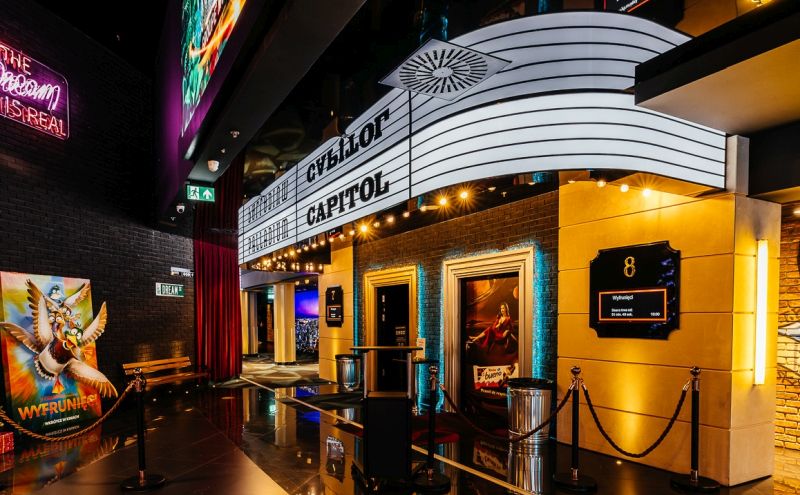
Each Helios theatre is uniquely presented, marketed, and managed. Pictured here is Helios Warsaw.
To understand that – and the achievements of Helios – is the role that a highly localized (and creative) approach plays, and the belief that exhibitors are best placed to know and develop a relationship with their audience.
“Your City, Your Cinema”
In the early 1990s, large international chains moved into Poland’s major cities. Helios concentrated on smaller towns, often as the only cinema. As competition intensified in the cities and the economy changed, some chains didn’t survive. But Helios had a strong enough foothold to make a move into shopping malls in larger cities. “We have 53 cinemas, but more than 20 are the only ones in the town,” explained Tomasz.
Each Helios cinema is uniquely presented, marketed, and managed. “We have a slogan which roughly translates as ‘Your City, Your Cinema’,” explained Tomasz. “We look to create a connection between us, the audience, and the movie.”
For example, in Kalisz, the cinema foyer takes inspiration from the ancient Amber Road. In Krosno, the iconic glass factory gave the cinema its lighting. The screens in the Warsaw cinema are named after old cinemas that used to be in the city.
“I wanted to recreate the best Western cinema in Poland and be proud of it. The goal was to change Poland.”
Marketing is equally creative and memorable. My favorite example is their promotion of “The Lion King.” The audience was given tissues and a little phial to catch their first tear drop, and members of a vocal group spread among the audience sang “Circle of Life” from the film’s soundtrack. You can see why Helios forges real, genuine connections with audiences.
The big international companies Helios competes with tend to be process-led and work top-down. But Tomasz has fostered a fundamentally different approach. “I want my managers to be known in their towns,” Tomasz shared. “For example, they could be friendly with the city’s mayor or invite notable guests to be part of a cultural experience, or perhaps work with local students. We are always open to their ideas. It comes from the time when I ran one cinema, and every week you must think how to get people to that film. This shaped me.”
Next Film: The move to distribute and produce local films
Tomasz extended the company into film production and distribution around a decade ago by establishing Next Film, which has focused from the outset on supporting and distributing Polish productions, and today also operates across international platforms. Tomasz explained that the initiative started as he saw the gap between arthouse movies, which tend to find state funding, and commercial movies. “Producing quality local films requires funding, not least to cover production costs. Plus, there is a scarcity of resources, producers, and personnel to make the films. As exhibitors, we know best what the customer needs. So, we decided to help make local films more commercially viable,” explained Tomasz.

The lobbies of Helios Kalisz and Helios Krosno take inspiration from local culture and history.
Next Film, it turns out, has an interesting precedent in Polish cinema history. “I am from Lodz. I discovered that before the Second World War, cinema owners in the city discussed which actors and directors should be in films. You like a project and you help it. It makes sense. Production is a step further; you finance everything,” said Tomasz.
The numbers speak for themselves. “In the last two years, Next Film has been responsible for 50% of tickets sold in Poland on locally produced movies,” Tomasz shared. “The main company goal is not to earn money for Helios (on distribution) but to guarantee sufficient local production. Locally produced films in Poland account for more than 20% of the tickets sold.”
A passion for Poland
After speaking to Tomasz, I spent quite a bit of time thinking about how the Helios story would make a fantastic local film with universal themes. An entrepreneurial human spirit triumphing over the confines and control of communism; a David and Goliath tale fending off threats from international companies. Perhaps most of all, the power of a singular focus and passion. “I wanted to recreate the best Western cinema in Poland and be proud of it. The goal was to change Poland.”