
Understanding the distinctions between virtual production systems
LED volumes have become the visual shorthand for virtual production. From trade shows to behind-the-scenes features, large LED stages often dominate the conversation. As a result, many teams assume that virtual production requires an LED volume to be viable.
It doesn’t.
Virtual production is defined by how digital environments are integrated into the production workflow, not by the display technology used to present them. LED volumes are one implementation of that workflow, but they are not a prerequisite.
Understanding this distinction is essential for studios, broadcasters, educators, and content teams evaluating whether virtual production is feasible for their space, budget, and goals.
How LED volumes came to dominate the conversation
LED volumes became synonymous with virtual production largely because of their visibility. High-profile productions demonstrated how large-scale LED environments could deliver in-camera realism, accurate reflections, and immediate visual feedback for performers and directors.
For certain productions, LED volumes may be the ideal solution. They offer high brightness, immersive scale, and complex geometry. However, those benefits come with trade-offs that are often overlooked in simplified narratives about virtual production.
LED volumes introduce considerations around cost, color, heat, power consumption, calibration, pixel pitch, moiré, fragility, and ongoing maintenance. They also tend to require significant physical space and infrastructure. These factors don't make LED volumes unsuitable, but they do make them context-dependent.
Virtual production is a workflow, not a display format
At its core, virtual production is about bringing virtual environments into the production process. This includes:
- Displaying digital environments on set
- Synchronizing cameras, lighting, and content
- Capturing usable imagery in camera, in post, or both
- Reducing uncertainty and rework downstream
None of these requirements inherently demands LED technology. They require precise synchronization, reliable displays, accurate color reproduction, and repeatable system behavior.
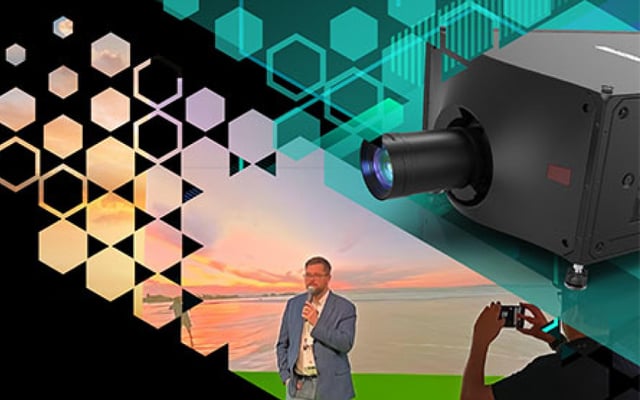
Projection-based virtual production not only meets these requirements, but also raises the bar for quality, flexibility, and efficiency.
The benefits of projection
Projection has a long history in professional visualization and cinema, and modern projection technologies have expanded what’s possible in real-time production environments.
In virtual production contexts, projection can enable:
- Multiple visual outputs within a single camera frame
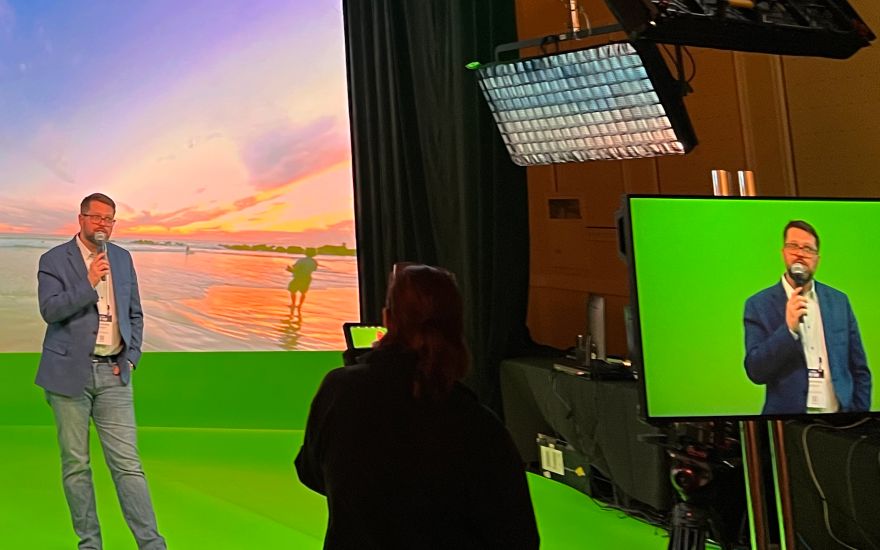
- Clean compositing options without physical green walls
- Natural-looking environments for talent on set
Because projection systems don’t have spaces between pixel structures, they can eliminate the risk of moiré patterns and pixel aliasing. For example, tight close-ups or longer lenses may exaggerate pixel pitch on LED tiles, while projection surfaces remain optically continuous. You can focus directly to the wall or screen surface when you use projection. In other words, for the first time in virtual production, you can perfectly simulate how the eye would naturally behave and focus.
"Projection-based virtual production not only meets these requirements, but also raises the bar for quality, flexibility, and efficiency."
Projection systems can also be powered down completely when not in use, reducing idle energy consumption and long-term system wear. This dramatically lowers operational costs compared to continuously energized displays like LED walls.
These characteristics make projection a logical choice for many productions that prioritize fidelity, flexibility, scalability, and controlled operating costs.
When LED volumes make sense, and when they don’t
RGB+ LED volumes remain a good option for productions that require:
- Extremely high brightness
- A light source for foreground reflections on objects like vehicles and armor
- Small spaces
However, not every production benefits from those characteristics, or has those restrictions. For most studios, broadcast environments, educational facilities, and live events, or corporate productions, the overhead associated with LED volumes outweighs their advantages.
In these cases, projection-based virtual production workflows can deliver better creative and operational benefits without the unnecessary cost.
The consideration between LED or projection should be centered around choosing the right system for the job, based on workflow requirements.
Reframing the virtual production decision
One of the most common barriers to adopting virtual production is the assumption that it requires large-scale infrastructure. That assumption often stops meaningful evaluation before it begins.
By separating the concept of virtual production from any single display technology, production teams can ask better questions, like:
- What level of realism is required on set?
- How much flexibility is needed during capture?
- Where should creative decisions be made, on set or in post?
- What systems need to scale over time?
These questions lead to solutions that are engineered around outcomes rather than constrained by preconceptions.
Virtual production without assumptions
Virtual production continues to evolve, and so do the technologies that enable it. LED and projection-based systems each play important roles within the broader ecosystem.
When virtual production is approached as a system of workflows and technologies, rather than a single display format, it becomes accessible to a wider range of creators and organizations.