
Learn about Virtual production, its methodologies, and use cases
Virtual production is changing how film, television, broadcast, and live content are created, and for many people, the term has become synonymous with massive LED volumes and big budgets. In reality, virtual production is a workflow, not a single technology, and it can be enabled in multiple ways.
At its core, In-Camera VFX virtual production brings digital environments into the production process earlier, allowing creatives and technical teams to see, shape, and capture final or near-final visuals during the shoot.
This article explains what virtual production is, how modern workflows function, and why both projection and LED technologies play important roles in building flexible, high-fidelity production environments.
To understand how these solutions fit, it’s important to start with the fundamentals.
"Projection enables virtual production workflows that would be impractical or cost-prohibitive with LED alone.”
What is virtual production?
Virtual production is a methodology that blends physical and digital elements in real-time production.
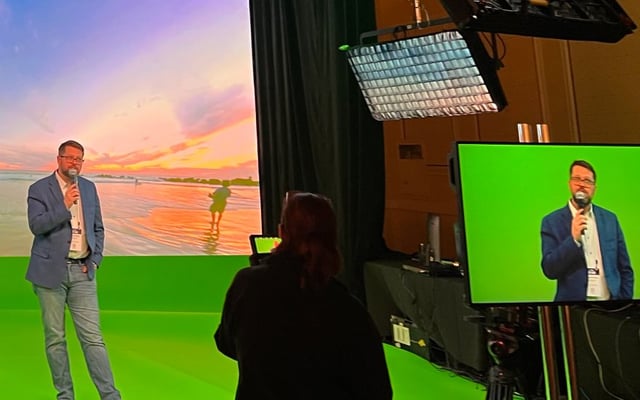
This may take the form of a feature film stage rendering a digital cityscape in camera, or a broadcast studio presenting a dynamic data-driven backdrop for live news, sports analysis, or election coverage. Instead of filming actors against blank green walls and building environments later, virtual production allows these environments to exist visually on set.
This approach changes two fundamental aspects of production:
- Creative decision-making happens earlier.
Directors, cinematographers, and performers can see environments while shooting, not weeks later in post. Lighting and performance become intertwined - Light, reflections, and visual context are driven by the environment itself.
Virtual production is not a format or a product. It's a workflow that connects displays, cameras, lighting, rendering engines, synchronization systems, and content pipelines into a single, coordinated system.
The core components of a virtual production system
While implementations vary, modern virtual production environments typically rely on the same foundational components.
Display technology
The display is what presents the virtual environment to the camera and to talent. This may be an LED wall, a projection surface, or a combination of displays, depending on the production goals, space, and budget.
Content and rendering engines
Game engines, plate-based systems, or hybrid approaches generate the virtual environments. These systems render content in real time and adapt it to camera movement, perspective, and framing.
Camera systems and tracking
Camera position, rotation, and lens data are continuously tracked so the virtual environment responds correctly to motion and framing. This preserves realism and spatial accuracy.
Synchronization and timing
Virtual production depends on precise timing between display, camera, lighting, and content playback. Frame accuracy and synchronization ensure successful capture and reliable compositing.
Lighting integration
Lighting systems are often synchronized with the displayed content so that foreground subjects match the virtual background in color, intensity, and direction.
When these elements work together, virtual production becomes repeatable, scalable, and reliable rather than experimental.
Understanding the virtual production workflow
Although tools differ, most virtual production workflows follow the same high-level sequence.
- Planning and pre-visualization: Environments, camera moves, and scenes are designed before the shoot. This reduces guesswork and allows technical requirements to be validated early.
- Environment creation: Virtual backgrounds are built using 3D assets, captured plates, or a combination of both. These assets are optimized for real-time playback.
- On-set integration: Displays present the environment on set, whether that means a cinematic landscape for a drama series or a responsive virtual studio environment for live broadcast. Cameras and lighting are synchronized to the content so performers interact with a believable visual space.
- Capture: Productions may capture final pixel imagery in-camera, clean keys for post-production, or both simultaneously, depending on the workflow.
- Post-production: As needed, compositing, color grading, and finishing are applied.
This workflow is what defines virtual production, not the specific display technology used to enable it.
LED and projection in virtual production systems
LED volumes have played a major role in popularizing virtual production. However, LED is not the only way to implement a virtual production workflow, and in many cases, it may not be the best way.
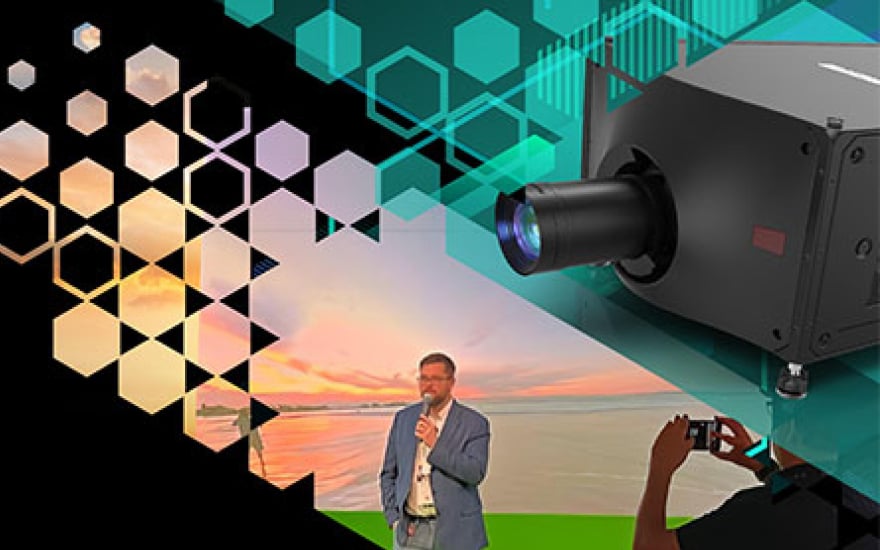
Christie projection-based virtual production systems offer a different set of advantages:
- Better color, fixing the white-point problem that generates ‘red-lobster effects’ in the foreground of RGB light systems. The Christie Sapphire® 4K40-RGBH projector is superior to even RGB++ LED panels in this capacity.
- With the right surface, the elimination of moiré artifacts
- More flexible setup.
- The ability to capture multiple visual outputs within a single camera frame – without a processor
- Lower upfront and operating costs to build and sustain: less power, less heat, less upfront costs.
In many cases, virtual projection enables production workflows that would be impractical or cost-prohibitive with LED alone. This does not make one approach universally better than the other. It reinforces the idea that virtual production is about choosing the right system for the job, not forcing a single solution.
Virtual production use cases
Virtual production is no longer limited to major studios. Modern workflows are now used by:
- Film and episodic television productions building large-scale environments in-camera
- Broadcast and live event teams creating dynamic, data-driven virtual studios
- Corporate and educational content creators producing scalable studio content
- Independent studios working within tighter space and budget constraints
For example, a news broadcaster may use virtual production to change studio environments between segments without physical rebuilds, while a live event team may deploy projection-based systems to create immersive branded environments within existing venues.
What matters most is not scale, but clarity of goals. Productions that benefit from early creative validation, flexible environments, and reduced post-production risk are strong candidates for virtual production workflows.
Why virtual production must be engineered, not improvised
The biggest failures in virtual production rarely come from creative ambition. They come from treating the workflow as a collection of disconnected tools rather than an engineered system.
Reliable virtual production requires:
- Display technologies designed for professional environments
- Precise synchronization across systems
- Repeatable workflows that scale beyond a single shoot
- Long-term thinking about reliability, maintenance, and evolution
Virtual production as a system
The real value of virtual production lies in the control, predictability, and creative freedom it offers to production teams.
By understanding virtual production as a system of workflows and technologies rather than a single display format, production teams can make smarter decisions about how and when to adopt it.
This foundation makes it easier to evaluate specific solutions, including projection-based approaches and LED environments, and to choose the right path for each production’s needs.