
Our product manager talks about the key factors and differentiators of a MicroTiles LED video wall
Previously, we spoke with our product management team about calibrating LED video walls and how MicroTiles® LED does it better. In this follow-up article, we caught up with the team to discuss the design and installation of LED video walls and where MicroTiles LED differs from other solutions on the market.
Designing a video wall
When planning an LED video wall, there are several factors to consider, including the space, viewing distance, brightness, and the cooling and ventilation of the wall.
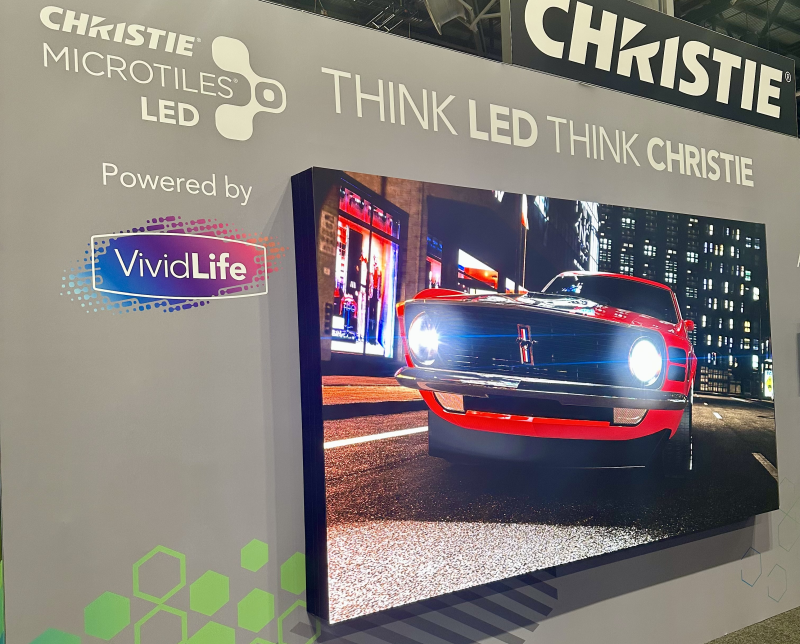
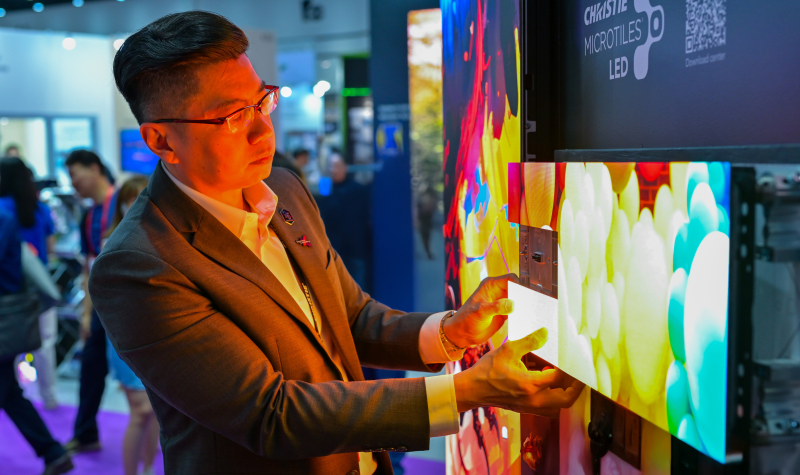
A MicroTiles LED video wall on Christie's booth at IAAPA Expo 2025.
When it comes to the actual design of a video wall, there are a couple of tools that users can tap into. First, we have an online LED designer tool for flat and rectangular LED video walls. Enter in a few properties of your space, select your Christie LED technology, and the designer will provide a reference diagram and generate a bill of materials.
Second is design assistance for MicroTiles LED video walls. Design assistance encompasses all elements necessary to prepare the space, including mechanical details for proper mounting, as well as power and HVAC requirements tailored to the specific use case, to ensure maximum efficiency of the video wall.
Incorporating redundancy
We know that some projects, like mission-critical control rooms and theme park attractions, require built-in redundancy because system downtime can have a direct impact on business. With MicroTiles LED, power and data are redundant by default, with options to increase redundancy by doubling up on wall controllers and even source equipment.
Christie product manager Richard McLean explains that the power side is always redundant due to an n+1 rectifier configuration (ie, a back-up rectifier) in MicroTiles LED power shelves. “This means that there is always one more rectifier in the shelf than is necessary, so that if one of the rectifiers were to fail, there would still be enough power to keep the display running,” explains Richard. “In the case where a rectifier fails, alarms can be set up to communicate the issue to the necessary parties. Rectifiers are hot swappable, so replacing a failed unit has no impact on the display functionality.”
“On the signal side, MicroTiles LED sends video data via a 40 GB loop to all the devices in the chain necessary to drive the display,” says Richard. “This data travels bidirectionally when everything is functioning correctly. If there is a break in the data path somewhere, the data can still travel to the relevant devices in the chain, but not in a bidirectional loop. If this happens, system alarms will indicate a break in the data loop, and the UI's functionality will help technicians determine the location of the break so that it can be addressed.”
MicroTiles LED features tiles that can automatically detect and self-locate.
For additional redundancy, two Christie Link E1000 video wall controllers can be run in parallel, with the input signal duplicated on each. This ensures that if one fails, the display won’t be impacted.
Beyond the rectangle
With MicroTiles LED, the size and shape of your video wall is almost unlimited. The size of the display can be scaled to meet the project's requirements, and the small size of the tiles allows for 90-degree convex and concave corners, as well as non-continuous patterns, such as an architectural display or a “shatter wall” (which we’ve showcased at ISE and InfoComm International).
“If you have an idea for a video wall, we can help,” says Richard.
If you’re considering an LED display for your next project, we’re here to help.
Download our LED video walls 101 whitepaper.
You’ll find links to additional resources below, and contact us with any questions.