
When the lights darken in the cinema auditorium, the magic begins as audiences are transported to new worlds. Bringing that movie magic to life requires a projector that delivers a director’s vision with consistently stunning visuals.
As modern cinema continues to evolve with new theatrical formats that demand higher frame rates, wider color gamut, and brighter images, the audience's expectations evolve with it. While the audience’s focus will always be on the storytelling, exhibitors and filmmakers know that cinema projection technology needs to evolve to meet audience expectations and ensure the continued success of the cinema industry through unforgettable big-screen experiences that can’t be replicated at home.
Beyond the onscreen visuals and audience experience, exhibitors need the economics of exhibitions to evolve as well, with lower operating costs, reduced energy consumption, and longer projector lifespans.
Let’s take a closer look at what you need to consider when selecting a projector that’s right for your cinema, including illumination technology, electronics, image quality, operating costs, and support for content today and in the future.
Cinema illumination technology: Understanding your options
At the heart of every cinema projector is the illumination system, which helps determine the brightness, color gamut, contrast, operational lifetime, and energy consumption of the projector. As the cinema industry continues to evolve, solid-state laser projection is becoming the industry standard.
Solid-state laser cinema projection includes both RGB pure laser and hybrid laser illumination technology. With laser illumination, you eliminate lamp replacements, reduce energy consumption compared to equivalent brightness legacy Xenon projectors, and maintain brightness consistency over years of operation through technologies like Christie LiteLOC™, which actively regulate light output.
RGB pure laser illumination
The industry’s widest range of cinema projection systems, period.

RGB pure laser illumination uses dedicated red, green, and blue lasers to deliver greater brightness, richer color, improved efficiency, and more accurate visual representation. Christie RealLaser™ illumination technology powers our RGB pure laser cinema projectors and delivers long-term stability and operational lifetimes that can exceed 50,000 hours at reduced brightness and meet — or even exceed — DCI standards. With brightness levels ranging from 15,000 to 57,000 lumens, our CineLife+™ RGB pure laser lineup delivers exceptional performance for cinemas of all sizes: from mainstream cinema screens up to 52′ wide to premium large format (PLF) cinemas with 114′ wide screens.
Enhanced laser phosphor illumination
Phazer: enhanced laser cinema projectors

Designed for small to mid-sized cinemas, high-gain screens, and post-production houses, projectors with an enhanced laser phosphor design, such as our RBe and RGBH projectors with Christie Phazer™ illumination technology, offer a highly efficient, reliable, DCI-compliant laser light source for auditoriums with screens up to 64′ wide.
Ranging in brightness from 6,000 to 11,000 lumens, our RBe model projectors deliver enhanced image performance on high-gain screens with our CineLife+2K™ electronics platform designed specifically for the needs of 2K resolution projectors.
Hybrid laser illumination
More options with hybrid laser cinema projection

Our 4K RGBH hybrid laser projectors combine RGB pure laser and laser phosphor illumination technologies and range from 10,000 to 20,000 lumens. With RGBH projectors, exhibitors and post-production houses benefit from reduced speckle, improved color uniformity, and the world's most efficient cinema projection.
When deciding between RGB pure laser, hybrid laser, laser phosphor, and Xenon, it comes down to your operational and financial considerations, including screen size, annual screening hours, available capital budget, and operating cost tolerance. One thing you can be sure of: No matter which type of Christie projector you choose, you can count on the benefits of our advanced CineLife+ electronics platform in your projector.
The electronics platform: Where capability is defined
If illumination technology is the muscle of a cinema projector, then its electronics platform is the brain. A projector’s electronics determine the content formats it can accept and display, how quickly it processes images, available connectivity options, integration with theatre management systems, and what monitoring and automation tools are available.
When evaluating cinema projection systems, you need to look at the electronics platform to determine whether the projector is future-proofed to support high bit-rate content up to 4K at 120 Hz. Older systems, regardless of whether they use laser or Xenon illumination, often lack the processing speed, connectivity, and format support needed for high frame rate content, advanced 3D, and integration with modern theatre management systems.
Initially designed for premium large format (PLF) cinemas, our advanced Christie CineLife+ electronics platform with ultra-fast Series 4 processing electronics is available in projectors for cinemas of all sizes. With CineLife+, you get unique features like:
- Electronic color convergence for perfect lateral color error correction throughout your entire onscreen image, and allows you to easily adjust color convergence via remote control.
- Integration with Mystique Cinema™ for automated alignment in multi-projector configurations.
- ScreenFit™ for simplified keystone correction.
- HDMI 2.0 connectivity, unlike older-generation platforms.
Projection performance: Color, contrast, and control
The brightness and resolution listed on a spec sheet tell only part of the story when it comes to the on-screen quality that audiences see.
Inside each of our cinema projectors, the 3DLP® architecture uses three Digital Micromirror Devices (DMDs), one for each color: red, green, and blue, providing a native advantage in color accuracy and contrast over single-chip DLP® designs that rely on color wheels or temporal color sequencing. This color accuracy is important for cinema projection, as the image on screen must match the approved color grading to realize the director’s vision.
Key processing capabilities also include contrast for better depth and detail in dark scenes, uniformity correction to ensure consistent brightness and color from corner to corner of the screen, and motion processing for smooth, clean image rendering during fast-moving sequences.
Our CineLife+ projectors also include processing capabilities for lens memory, allowing rapid switching between aspect ratios, and support for automation workflows that integrate projection with lighting, audio, and curtain systems.
Format support for future-proof cinemas
As filmmakers continually push the boundaries of what’s possible and the theatrical content landscape evolves, projection technology must evolve alongside it to meet those new creative standards.
While standard 2K and 4K DCP playback remain the baseline requirement, new premium formats are being developed. Blockbuster films are being released as high frame rate (HFR) content at 48 fps, 60 fps, and120 fps, while Dolby Vision and other high dynamic range (HDR) formats require specific projector capabilities.
In our 4K CineLife+ projectors for PLF auditoriums, there’s the added benefit of support for 4K 3D up to 120 frames per second, a capability currently unique to these projectors. This high frame rate capability eliminates the motion blur that large screens amplify, particularly in fast-moving content like action sequences and high-energy concert films.
Cinema projectors have an operational lifespan of up to 12 years, so you need one that can meet the demands of the evolving cinema industry and new content formats. The electronics platform determines whether your projector supports formats that aren’t yet widely available. That’s why a platform designed with headroom for future processing demands, such as higher frame rates, new HDR standards, and evolving DCI specifications, protects your investment in a way that a platform designed only for today's requirements can’t.
Our CineLife+ Series projectors are designed with this innovative, forward-looking philosophy. CineLife+ processing architecture not only supports current formats but also provides upgrade paths for emerging ones, and its connectivity supports integration with next-generation theatre management and automation systems. Another way our CineLife+ projectors meet those changing creative standards is with Christie VDR™. When enabled on a projector with RealLaser, precise interframe laser power control delivers contrast up to 10,000:1, revealing subtle textures, shadow detail, and depth in dark scenes so your audience sees exactly what the director intended.
Operating costs and your total cost of ownership
The purchase price of a cinema projector is the most visible cost when choosing a projector, but it may not be the largest one over the lifetime of your system. Operating costs, such as energy consumption, maintenance, lamp replacement, and cooling requirements, accumulate over the years and can even exceed the initial capital expense. That’s why the total cost of ownership (TCO) is an important consideration when you’re deciding which projector to purchase.
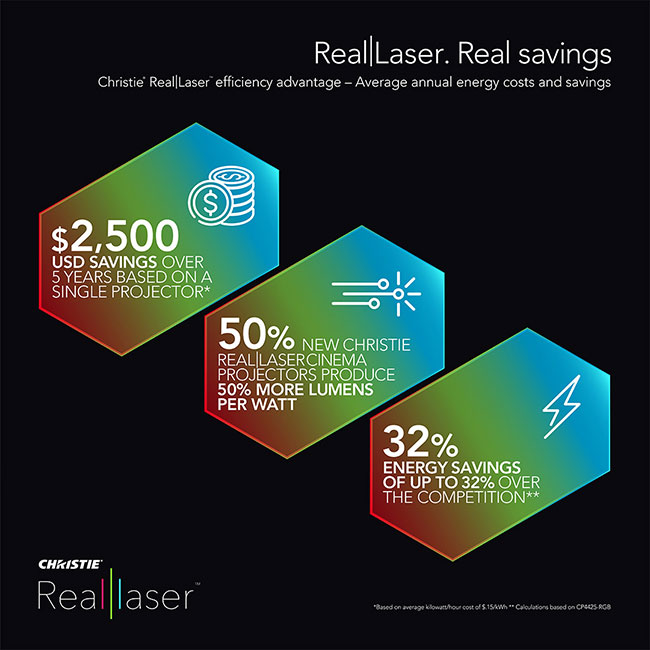
The average annual energy costs and savings with Real|Laser projection
Energy consumption can vary significantly between illumination technologies and between generations within the same technology. Today’s laser cinema projectors consume less power per lumen than equivalent-brightness Xenon systems, while their energy profile remains stable over time, rather than declining as lamps age. Not only are they more energy efficient, but they also require fewer consumables, since there are no lamp replacements.
Our cinema projectors with Phazer or RealLaser illumination technology produce more lumens per watt than any other projector on the market, which means they use less power to produce more on-screen brightness, lowering your overall operational costs. You can further reduce total operating costs for CineLife+ projectors with RealLaser by enabling VDR, which reduces laser power consumption by up to 30% and extends the laser lifetime by up to 50%.
Maintenance requirements also factor into the TCO of your projector. Laser illumination systems eliminate lamp replacements, including labor and the logistics of maintaining a lamp inventory. They also reduce the frequency of optical path maintenance since laser modules don't produce the same thermal load as high-wattage lamps. While Xenon projectors require regular lamp changes, filter maintenance, and more frequent optical cleaning, the higher TCO is well-understood and predictable and is balanced by a lower upfront cost.
Downtime is one of the biggest concerns for cinemas. If a projector fails during a screening, it affects your ticket revenue, concession sales, and audience satisfaction. To manage that risk, it’s important to consider the projector's reliability, whether remote diagnostics are available, and the quality and speed of the manufacturer's service response when you’re assessing the true cost of ownership.
What cinema exhibitors should evaluate
When making projection decisions today, there’s a long list of factors you need to evaluate as you consider which cinema technology is the right choice for your theatre. That list includes:
- The electronics platform and its format support roadmap
- Which illumination technology best fits your operating model
- The total cost of ownership, including energy efficiency and maintenance costs
- Compatibility with your theatre management and automation systems
- The manufacturer's service and support infrastructure in your region
- The manufacturer’s track record of supporting products through firmware updates and technology upgrades.
As you dive into those factors, it quickly becomes clear that the best projector isn’t necessarily the one with the lowest price tag. It’s the projector you can count on to consistently deliver the best visuals and performance on day one and over its full operational life. Projectors that achieve that kind of consistency are the result of engineering decisions made at the platform level and the trusted support of a manufacturer with the depth to stand behind its products — something you’ll find in both our innovative cinema technology and our Professional Services.
If you’re ready to start looking for your next cinema projector, then you can explore our lineup to find the right projector for your theatre, and learn more about our latest advances in cinema technology, such as Phazer and VDR.
Explore more Christie technology
Learn more about how we power professional visual displays across a range of applications:
- Cinema projection systems: Delivering consistent image quality in modern theatres
- Professional projection systems for large-format and high-brightness environments
- LED video wall display systems for enterprise and large-scale environments
- Immersive projection and visualization systems for large-scale environments
- Control room display solutions for mission-critical visualization
- Large-venue projection and display systems for high-impact events