
How Dreamlab Immersive created a projection mapping experience in a historic venue
Photo credit: LHMC Hotels
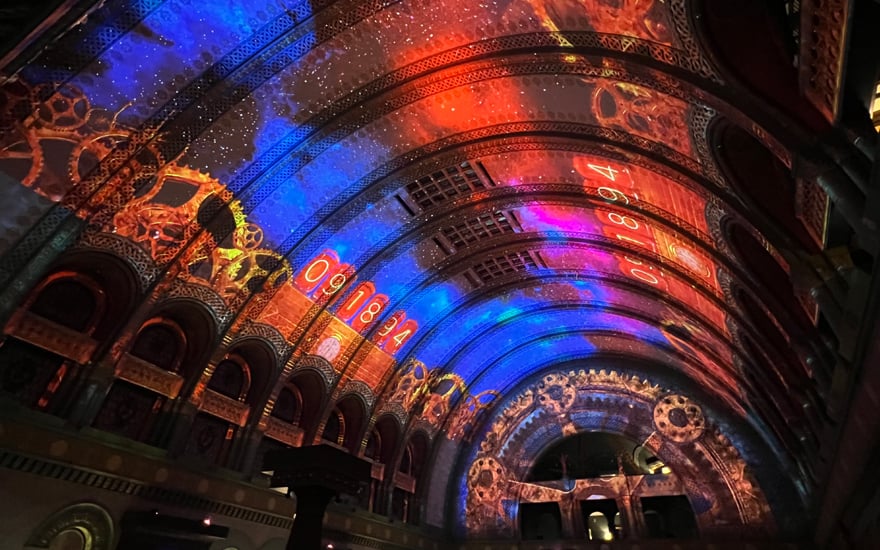
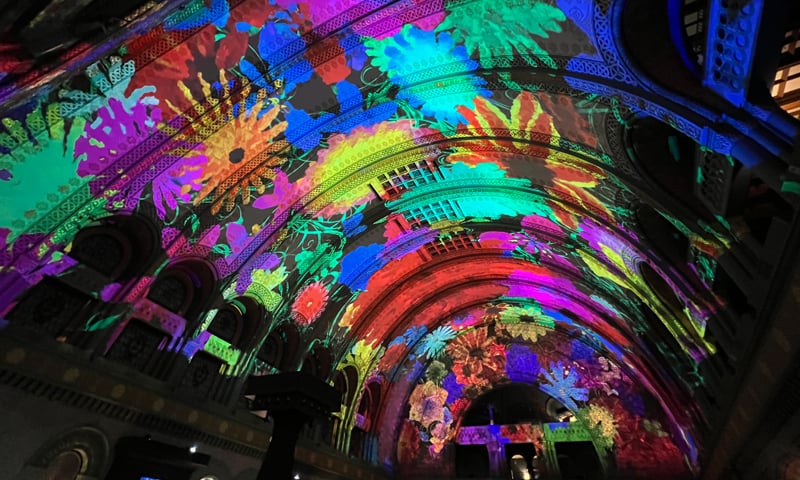
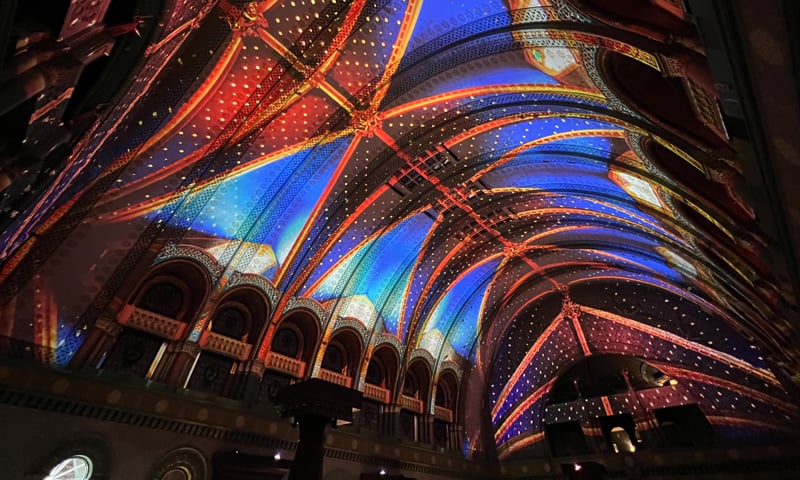
The Grand Hall Experience at St. Louis Union Station has been dazzling visitors with a nightly projection mapping show since 2014. The experience, featuring vignettes that tell the story of the 130-year-old historic landmark and highlight the building's ornate architecture, recently underwent a major AV and content upgrade by DreamLab Immersive. The refreshed attraction is set to wow guests with standout visuals and dynamic content.
We had the opportunity to speak with DreamLab Immersive’s John Miceli to learn more about the Grand Hall Experience, the technology behind it, and what it means to deliver an immersive experience in a historic venue.
Tell us a little about yourself!
I’m John Miceli, founder and executive creative director of DreamLab Immersive. DreamLab is my third founded company in my 35-year career, I’ve been blessed with incredible projects around the globe and working with the best of the best talent in the industry. I’ve spent my career at the intersection of storytelling, media technology, and immersive experience design, leading projects that bring architecture and narrative to life in innovative ways.
What was the catalyst and goal of the refresh of the Grand Hall Experience?
Union Station’s Grand Hall Experience is the recipient of a THEA Award and IAAPA Brass Ring-winning attraction that has been experienced by over 8 million guests in its 11 years since opening. It has been a signature landmark since its opening in 2014, but after 11 years, both Lodging Hospitality Management (LHM) and DreamLab saw an opportunity to raise the visual and emotional impact. The primary goal was to bring the experience up to current technological standards, upgrading to higher resolution, smoother frame rates, richer color, and more dynamic shows, while preserving the architectural integrity and magic of the space. LHM recognized that a refresh would not only delight guests but also reaffirm the Grand Hall’s position as a must-see, immersive destination for events and visitors.
When did you begin working on the project?
In 2013, longtime colleague Shawn McCoy contacted me with the opportunity to envision some spectacle for this beautiful architectural gem. We collaborated and landed on projection mapping on the ceiling filled with detailed filigree and color. There were many complications we had to overcome in this historical building, but with the assistance of our projection specialist Drew Atianza, we created the perfect design. Fast forward… Our new updated design process began in 2025, once LHM formally commissioned DreamLab Immersive for the update. Working closely with Phil Berard, we landed on Christie this time since they have leapfrogged all other brands with what we needed in super-high quality at a fair pricing range. From planning and technical evaluation to installation and content creation, it’s been a focused initiative to deliver a fully modernized experience.
What was the scope of the project?
The refresh was quite comprehensive. We replaced the aging projection hardware with Christie Griffyn® 4K50-RGB projectors for the endcap (wall) projections, and 12 Christie DWU2400A-JS Jazz Series projectors for the barrel-vaulted ceiling. In addition, we installed brand new VYV Xenon servers for their performance, reliability, and compatibility with high-frame-rate content. We didn’t just patch things up, we rebuilt the system from fiber to lens to suit a next-generation immersive show environment.
Was the content refreshed as well? And if so, what will guests see during the show?
Yes, that was a major part of the update. With the new hardware and server capability, we’ve expanded the coverage and re-rendered all existing shows to 16K resolution at 60 frames per second, giving each vignette even more clarity, depth, and fluid motion. On top of that, we have been asked to create two brand-new shows, bringing the total to 12 new and refreshed experiences that play each night. Guests will see familiar themes, historic rail references, architectural motifs, nature sequences, but elevated with richer detail, more dynamic transitions, and enhanced color fidelity.
Why did you select Griffyn 4K50-RGB projectors for this project?
There were several compelling reasons. First, brightness: the 50,000-lumen Griffyn 4K50-RGB is powerful enough to overcome the ambient light in the Grand Hall during the day to expand on the ability to play daytime shows without washing out the projection.
Second, color: the RGB laser architecture delivers a broader and more saturated color gamut, allowing us to produce vivid, painterly visuals and delicate tones that weren’t as achievable with older lamp-based or single-source projectors.
Third, resolution and frame rate: combined with our upgraded server infrastructure, we could push true 16K imagery at 60 fps, giving the show a much smoother, more cinematic feel than before.
Was there anything unique about this project?
Absolutely. St. Louis Union Station opened in 1894 and was designed by architect Theodore Link in the Romanesque Revival style. At the time of its opening, it was the largest and busiest railroad station in the world, serving as a central hub connecting the eastern United States with the expanding American West.
In 2012, Lodging Hospitality Management (LHM), led by Bob O’Loughlin, purchased the Union Station property with the goal of reimagining the historic landmark as a destination entertainment and hospitality complex. LHM’s strategy focused on restoring the historic architecture, creating unique visitor experiences, and transforming the property into a tourism anchor for downtown St. Louis.
The company sought a signature attraction that would draw guests into the Grand Hall and create a memorable nightly event within the historic space. LHM sought the support of Jack Rouse Associates (JRA) to help with the visioning. JRA reached out to me – at that time, I was President of Technomedia Solutions. Working with Shawn McCoy, we defined the winning approach, and he penned several of the historic story scripts. The concept evolved from a simple projection installation to a fully immersive multimedia experience spanning the entire Grand Hall after my face-to-face presentation with the team of LHM, thanks to JRA for funding the previz creation project.
The entire canvas is 65-feet tall, a 125-foot-long barrel vault ceiling with a 60-foot width. We had visual coverage of the two massive curved “end cap” walls, a 12.4 custom surround sound system with speakers I designed to control the echoing of sound in this very reverberant space. The technology was carefully concealed within architectural elements to preserve the historic integrity of the space while enabling a modern multimedia experience.
The Grand Hall Experience became the emotional centerpiece of the Union Station redevelopment, helping reposition the historic landmark as a tourism and entertainment destination. The attraction increased visitor traffic and hotel occupancy, reinforced the historic character of the building, and helped catalyze the broader redevelopment of Union Station.
Also, we were working in a live environment: the Grand Hall is a functioning hotel lobby, event space, and public lounge. So, installation had to minimize disruption, conceal equipment discreetly, and maintain the building’s historic fabric.
Finally, bringing together modern RGB laser projection, high-frame-rate media servers, and artistic content in a 19th-century architectural shell is inherently a unique creative and technical challenge. The best part of the process from 2014 to today is that the projector sizes, in some cases, have reduced in size, making the work somewhat cleaner.
Did you experience any challenges during installation? How were they resolved?
Yes, as with any retrofit of this scale in a historic venue, we faced a number of hurdles.
Mounting and concealment: Projectors and hardware needed to be installed without damaging or altering protected architectural elements. We originally worked with preservation architects and structural engineers to design the main towers for discreet stable installation.
Calibration: Aligning multiple projectors across a curved barrel ceiling and walls to blend seamlessly required precision. We dedicated significant time to 3D laser mapping and iterative calibration, to ensure perfect geometry and locking that in.
Show expansion and re-rendering: Rendering 10 shows in 16K/60fps with complex transitions was computationally intensive. Our team optimized pipelines and leveraged the VYV Xenon servers to manage load and playback reliably. Our creative team worked to expand the elevation of the media allowing us to add in extended media because the coverage was extended as well on the ceiling this time around.
We know a project of this size requires a team effort. Who was involved?
While DreamLab Immersive’s team, including Nathaniel Ruhlman, Phil Berard, Cesar Jovine, Don Belleveu, John V Miceli, and Aiden Jovine, provided the turn-key creative and technical services, we collaborated with Lodging Hospitality Management (LHM), who commissioned the work. Historically, in 2013, Jack Rouse Associates (JRA) was involved (they recommended us in the original build and remain an important partner).
Also, Ernest Bakenie and Christie for providing the projection hardware and incredible support, and Andrew Atienza and the team at VYV Media for their Xenon servers and support.
What has been the response to the refresh thus far?
The initial feedback from LHM has been overwhelmingly positive. They’ve expressed real delight at how vibrant, polished, and emotionally resonant the new shows feel. We are seeing detail now that we created in 2014 that finally has the technology that can bring it to the forefront and it’s overwhelming.
Guests are responding with the enthusiasm they did in 2014 and beyond when it launched. We are receiving comments on the clarity and luminosity, and even longtime visitors say they feel like they're seeing the Grand Hall in an entirely new light. The client has also noted how the longer-term reliability and performance of the new system will reduce maintenance overhead and give more flexibility for special event content.
Is there anything else you’d like to add?
I’d emphasize that this refresh represents not just a technical upgrade, but a reaffirmation of what immersive storytelling can be in a historic space. With DreamLab Immersive, our mission is to fuse artistry and technology in ways that deepen emotional connection, celebrate architectural heritage, and create memories.
This project is a powerful example of that ethos, blending modern visual storytelling with a space steeped in history. We are ready to take on any aging project that needs a refresh and look at it from a fresh lens, bringing revitalized expression and purpose to the experience.