

Learn how Christie RealLaser projectors improve energy efficiency without compromising performance
Article last updated July 30, 2026
Exhibitors consider many factors when selecting a new projector, from technical specs like brightness headroom and throw distance to visual performance in color spectrum and contrast ratio. One of the most important considerations, however, isn’t visible on the screen. It’s found in the projector’s operating costs, energy efficiency, and expected lifetime. These factors have a significant impact on a theatre's budget over time.
When you consider how these projectors typically operate 10 to 12 hours a day, seven days a week, understanding how much power they consume is important when evaluating the total cost of ownership. Older Xenon projectors often produce single-digit lumens per watt and require lamp replacements every 2,000 to 3,000 hours —an ongoing expense that exhibitors need to factor into their operating budgets. Christie CineLife+ projectors can produce nearly 15 lumens per watt (lm/w) while maintaining brightness for up to 50,000 hours. With VDR™ software-based enabling technology, some models can achieve up to 17 lumens per watt and up to 75,000 hours of operational life.
But efficiency isn't only about reducing operating costs. Lower power consumption can also help exhibitors support their sustainability goals while delivering exceptional on-screen performance. Let's look at how Christie technologies help cinemas maximize both efficiency and long-term value from their projection investment.
When exhibitors compare projection systems, there’s more to consider than the purchase price. Energy consumption, maintenance requirements, and expected operating life all contribute to the total cost of ownership. For projectors producing tens of thousands of lumens, energy costs—and potential savings—can add up significantly over time.
Why sustainability matters to cinemas
Caring for the environment is everyone’s responsibility, and exhibitors are increasingly looking for ways to reduce energy consumption without compromising image quality. Our exhibition partners consistently tell us that reducing energy costs and improving sustainability are among their top operational priorities. Whether it’s reducing the amount of product packaging or designing products that turn less energy into more lumens, we can make a difference. At Christie, we prioritize developing greener solutions to help minimize our environmental impact. while delivering industry-leading performance. Our exhibition partners consistently tell us that reducing energy costs and improving sustainability are among their top operational priorities.
It’s why we focus on developing cinema projectors that deliver more light output for every watt of energy consumed while still maintaining DCI-specified on-screen brightness for over 10 years of operation. Our range of RealLaser projectors also has the lowest CO2 emissions in the industry. Our CP4455-RGB pure laser cinema projector, for example, saves more than 36,000 kWh per year, equivalent to approximately 28.9 tons of CO2 emissions. That’s like removing about 5.6 cars from the road every year for each projector!
RealLaser delivers energy efficient cinema projection without compromise
Energy efficiency alone isn’t enough. Exhibitors also need exceptional image quality, reliability, and long-term performance. That’s where RealLaser illumination technology comes in. Researched, designed, and developed by our engineering team in Kitchener, Canada, our RealLaser illumination projectors feature compact, next-generation Multi Laser Pack Devices that achieve breakthroughs in brightness, color reproduction, image uniformity, contrast, and operational life.
RealLaser actually exceeds DCI specifications for color, contrast, and brightness, delivering a crisp, unmatched image on the screen. With an expanded color spectrum of 97% of Rec. 2020, it delivers more available brightness and the highest contrast ratio of 6,000:1, resulting in an incredibly efficient, performance-driven light source that drastically outperforms any other cinema illumination platform.
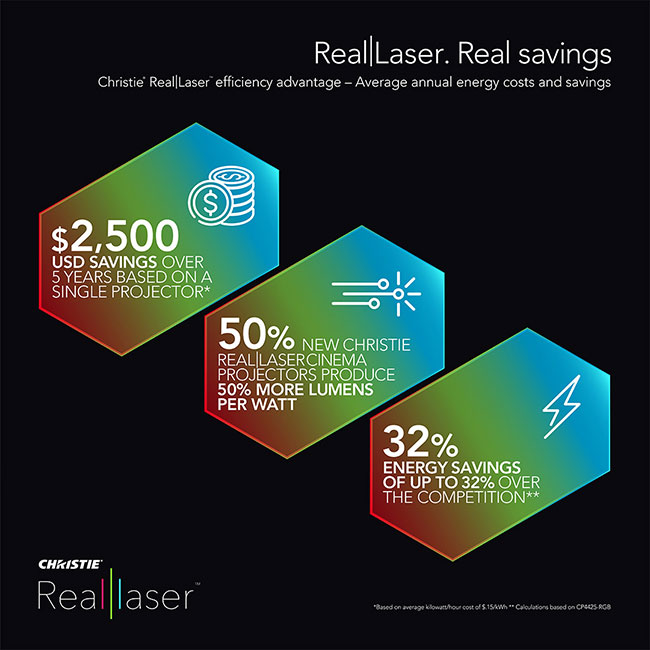
For mainstream cinemas, our CP4425-RGB and CP4435-RGB pure laser cinema projectors offer some of the highest energy-efficiency levels available in DCI-compliant projection today, helping exhibitors reduce operating costs without sacrificing image quality. And, for boutique cinemas, the CP2415-RGB and CP2420-RGB 2K cinema projectors produce up to 12 lumens per watt.
Phazer: Bridging the gap between Xenon and laser projection
While RealLaser reigns supreme for the market's upper-level brightness requirements, not every auditorium needs that level of light output. That’s why we developed Phazer™ illumination technology to bridge the gap between Xenon and laser projection. Delivering 6,000 to 20,000 lumens at more than 14 lumens per watt, Phazer projectors combine many of the efficiency benefits of laser projection with the operational reliability and color uniformity exhibitors value in Xenon-based systems.
For exhibitors upgrading from older equipment, Phazer cinema projectors provide a practical path to lower energy consumption, longer operating life, and reduced maintenance requirements.
“Our laser cinema projectors use less power to produce more brightness on screen—helping exhibitors reduce operating costs without sacrificing image quality.”
VDR: Better projector performance, lower energy use
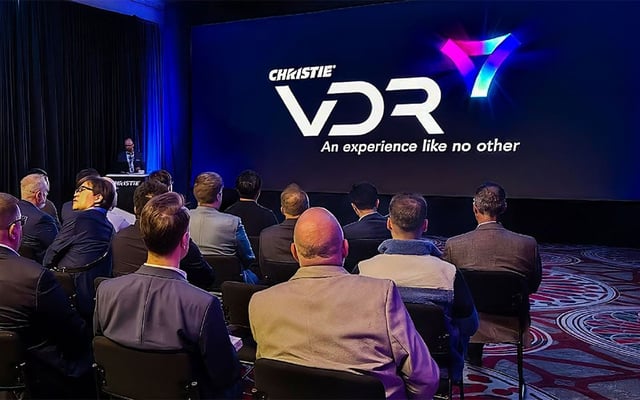
It’s rare for a technology to improve projector image performance while also reducing operating costs, but that’s exactly what VDR is designed to do. VDR is a software-based enabling technology that increases both the contrast and efficiency of our RealLaser projectors. With VDR-enabled, CineLife+ RealLaser projectors can achieve up to 17 lumens per watt, further improving operating efficiency and reducing energy costs for exhibitors. VDR can also reduce strain on the laser system, extend projector lifespan, and help exhibitors maximize their return on investment.
Best of all, these benefits aren't limited to premium large-format auditoriums. VDR helps improve efficiency and enhance image performance on mainstream cinema screens worldwide.
Understanding projector energy guides
Making an informed projector purchase requires more than comparing brightness specifications. That’s why we created our energy guides to make it easier to understand how efficiently a projector operates and what that means for long-term operating costs. Every Christie cinema projector has a guide that includes key metrics such as lumens per watt, BTU output, and estimated annual operating costs, to give exhibitors a clearer picture of the total cost of ownership.
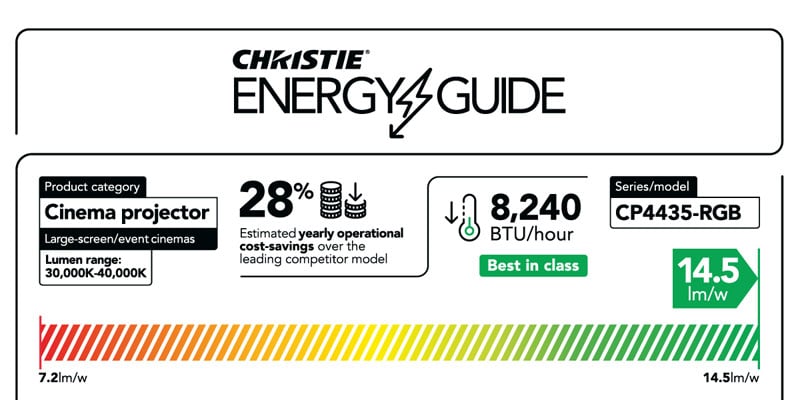
By making energy-performance data readily available, exhibitors can compare solutions more effectively and select the cinema projector that best meets their operational, financial, and sustainability goals.
Lumens per watt measure how efficiently a projector converts electricity into visible light. The higher the number, the more brightness a projector produces for every watt of energy it consumes. Higher efficiency can translate into lower energy costs and reduced environmental impact throughout a projector's life.
Continuing our legacy of light – and innovation
As cinema technology continues to evolve, exhibitors need solutions that balance outstanding image quality with long-term operating efficiency.
We'll continue to help exhibitors by developing cinema projection technologies that advance color, contrast, brightness, and energy efficiency, so they can reduce costs, support sustainability initiatives, and deliver exceptional movie-going experiences for years to come.